Neural Lander
I saw a blog post about a team that used GPT-6 Astra to edit weights in a different model (Qwen3.5-4B) to fix a reasoning loop issue that wrecked Qwen’s math scores. The updated Qwen then performed substantially better than the original model for math problems. This didn’t work as well for other models, such as Gemma, because there wasn’t as obvious of an issue. Still, its interesting to think about how an LLM is capable of understanding a neural network.
I saw another post on BlueSky where someone had used this paper as an inspiration to create a little lunar lander simulator where the weights were generated by a model without a training step. I thought that sounded neat, so I whipped up my own version. The process went differently than I expected.
I had Claude Opus 5.5 generate the weights directly for a 2-D lunar lander simulation. The lander starts from 15km above the surface at orbital velocity and the neural nets control the throttle and pitch of the lander to make a safe landing on the pad. The terrain is randomly generated, but a landing pad is guaranteed to be available. Claude created a control loop using classic control system theory, then built a compiler to convert the control loop to a neural network. A bit of a different process than I envisioned, but I had also wondered about the convertability of the neural nets and conventional control system loops.
Version 1 of the net was the result of Claude thinking hard and putting down the settings likely to result in a successful landing. In Version 2, Claude made several rounds of changes, including adding another layer to the network to better handle altitude corrections. None of these changes were from searching for parameter. Each change was the result of correcting a specific failure in v1. The v1 net had an 84% success rate, while the final v2 net was 100%, each across 3000 runs. Pretty good odds, though this is still an idealized environment where everything works perfectly and the telemetry is always correct.
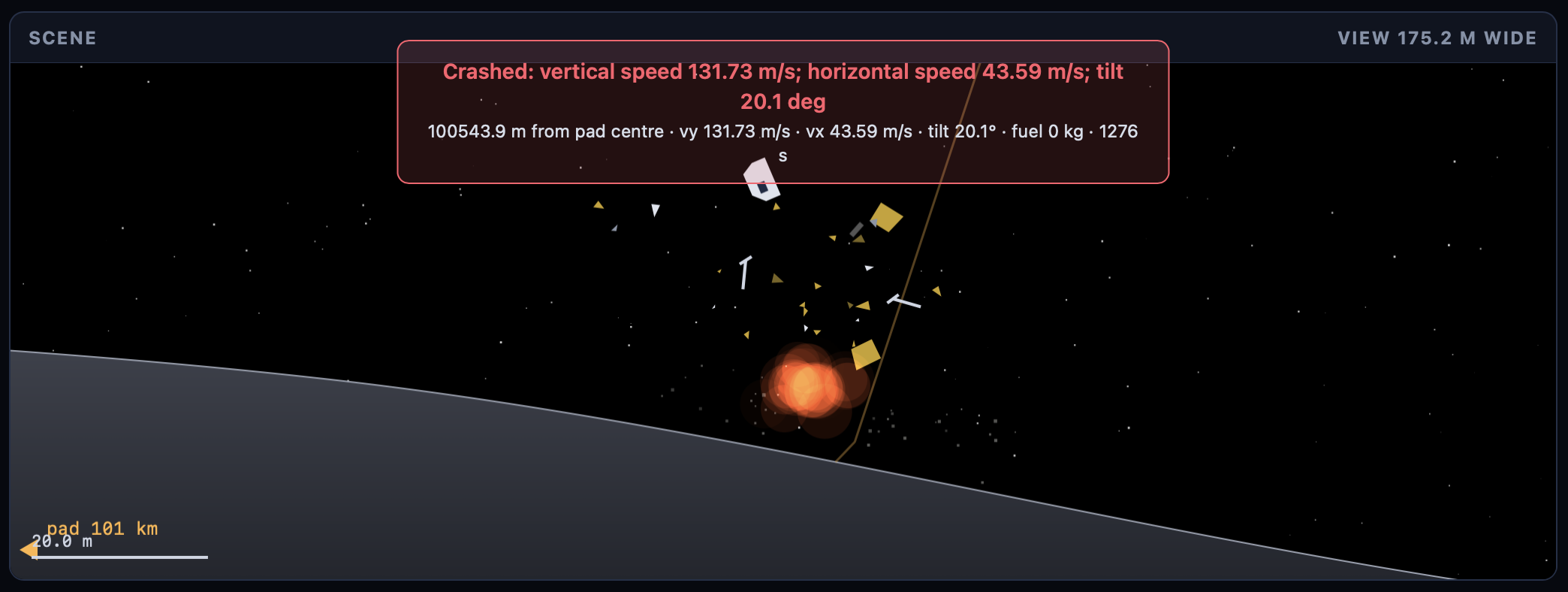
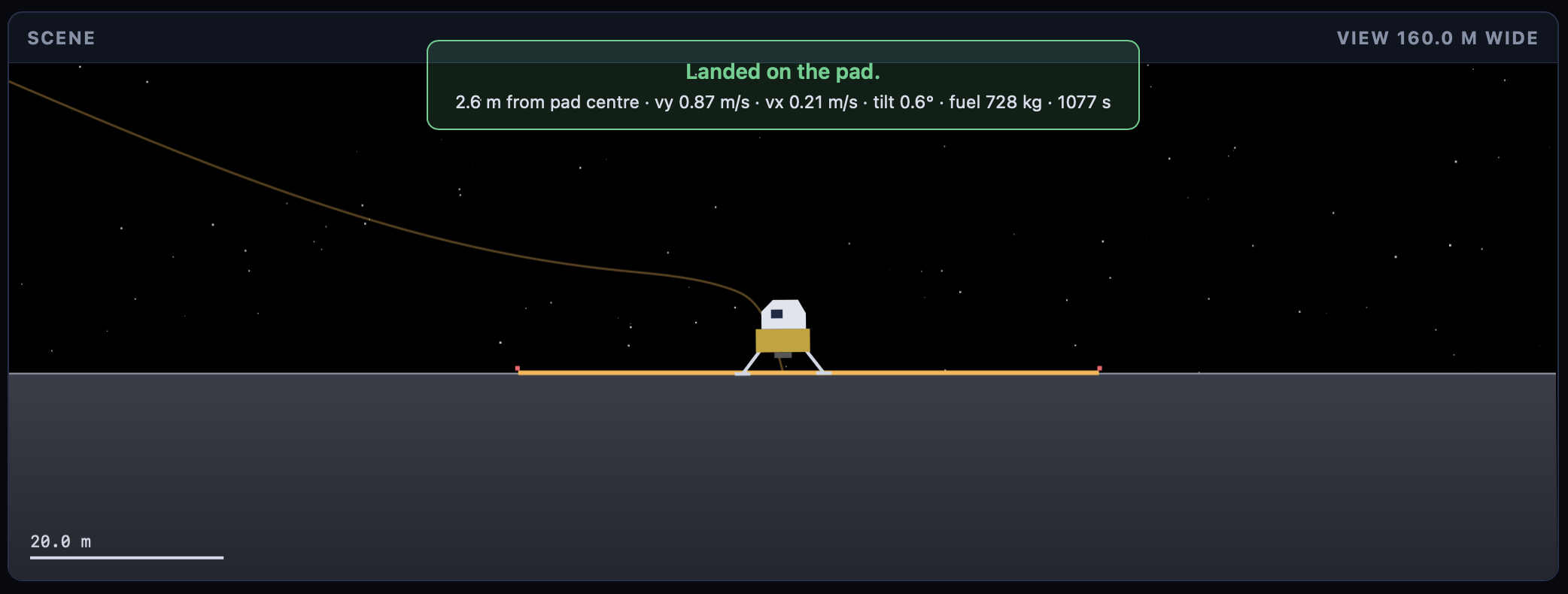
The interface shows the simulation, the neural net with the neurons and links firing, and the equivalent control loop. You can also try landing the craft yourself if you think you can do better. The “Nudge” button gives a random jolt to the lander so you can see how well the system reacts to sudden changes. The nudge button was added after the v2 net was finalized, so it hasn’t been adjusted to account for dynamic changes. A ghost mode was added so you can compare how the net did against an ideal version of the control system. Check out seed 36 to see a 9 km spread between the net and the ideal systems.
Some other things to add in the future are random equipment failures on the craft to see how robustly the system handles issues. I think I’ll do another post on the math behind the system one of these days. Give it a try!